After two years in Guyana, Stephen Harding (Education Management Specialist), his wife Mary (Literacy Specialist) and Meg Caton (SEN Specialist) have returned home. This is what was said about them in the Guyana Chronicle PepperPot.....
VSO trio have headed home
Taking with them bittersweet memories
By Vanessa Narine
“We just booked our tickets, but we will be taking Guyana home in our hearts.”
.jpg) These were the words of Voluntary Service Overseas (VSO) volunteers Ms Meg Caton, Mr. Stephen Harding, and his wife Ms. Mary Harding; three individuals who, after meeting for the first time two years ago, have found fulfillment, fun and friends for life, as they served as volunteers based at the National Centre for Educational Resource Development (NCERD).The three, who supported the Education Sector here with their various talents, are bound for the United Kingdom (UK) and will be leaving next Saturday as they set off to reunite with family, and experience new things.“I am going home to two grandchildren expected over the next few weeks,” Meg Caton said, bitter-sweet emotions emanating from her words.She described her experience here as everything from exciting, rewarding and amazing to challenging and new.
These were the words of Voluntary Service Overseas (VSO) volunteers Ms Meg Caton, Mr. Stephen Harding, and his wife Ms. Mary Harding; three individuals who, after meeting for the first time two years ago, have found fulfillment, fun and friends for life, as they served as volunteers based at the National Centre for Educational Resource Development (NCERD).The three, who supported the Education Sector here with their various talents, are bound for the United Kingdom (UK) and will be leaving next Saturday as they set off to reunite with family, and experience new things.“I am going home to two grandchildren expected over the next few weeks,” Meg Caton said, bitter-sweet emotions emanating from her words.She described her experience here as everything from exciting, rewarding and amazing to challenging and new.
Working with Mary Harding in Curriculum Development, Meg conveyed the feeling of satisfaction that came from visiting schools all across Guyana and seeing children being happy to read.
 “Seeing them use the materials we helped develop, and the joy they got from reading was extremely rewarding,” she said.However, besides the rewards of her professional stint in Guyana, Meg said she was delighted at being a part of the Guyanese culture, and the many major events that occurred during her stay here.Mary Harding echoed Meg’s sentiments, and singled out World Cup Cricket, the Caribbean Festival of the Creative Arts (CARIFESTA), plays at the Theatre Guild Playhouse and the National Cultural Centre; the celebration of Mashramani, Diwali, Phagwah and Christmas as being among the most enjoyable moments she’d had over the years.“The togetherness of the Guyanese people during these events, and the integration of everyone, regardless of religion, into the other’s celebrations exemplifies the country’s motto: ‘One People, One Nation, One Destiny’,” Mary declared, excitement at the memory evident in her voice.She went on to say that not only did this spirit exist during playtime, but also during the course of work as working at NCERD involved teamwork as well as team spirit.“Working with curriculum development at NCERD was working as part of a team that was focused on improving literacy, and improving individual skills in Guyana in a mass literacy countrywide programme, the Fast Track Initiative (FTI), which targeted head teachers, practicing teachers and educators,” Mary said.Mary also said that apart from the oneness one felt, life here was very different from that of life in London, particularly the lifestyles of persons in the outlying areas of Guyana.Mary’s husband, Stephen, who worked in Education Management, echoed her sentiments, but added that while they had come with no idea of what to expect, they were, nevertheless, stunned.“The differences are countless, but one thing I appreciate very much is that Sundays in Guyana remains a day of rest.
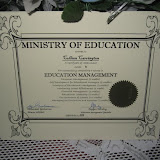
The traffic lights blink amber throughout the day; Guyanese take time to go to their religious bodies; and Sundays are distinctly different,” Stephen said, seemingly lost contemplating the differences.His colleague, Meg, also recalled her many Sundays in Guyana, saying that in London, Sundays were just normal days.“Persons should try not to change Sundays, since it is a special time that some take for granted,” Meg said.Stephen continued his reminiscence as he pointed to one moment in several “special times” he experienced and said in all his years of work, never did he have a view of the ocean as he did while working with NCERD.“I had the perfect view of the Atlantic Ocean, and we could always tell before anyone when the rains were coming,” he recalled laughingly.Another special moment for him was the completion of a programme he wrote to assist in the training of School Managers, the Education Management Certificate Course, a programme that has seen over 350 graduates countrywide since its initiation.“There is a genuine thirst for knowledge in Guyana; people want to learn, especially now that the programme has activities to stimulate persons during the lectures,” Stephen said.
He said that since the fourth batch of school managers completed the 18-month course, over 600 individuals have expressed their interest in the programme, which it is hoped will continue as part of NCERD’s commitment to training.“The programme, which was developed in 1990 for schools in Africa, was now completely fitted to Guyana and its environment,” Stephen said proudly. “We have achieved far more than we had expected, and it is very satisfying.”The three agreed that while the two years they spent here simply “flew by,” the satisfaction they gained was well beyond their expectations, not just work-wise, but in other respects as well, particularly the Guyanese cuisine and of course Guyana’s tourist attractions.
“The best trips we had were our visits to the Kaieteur Falls and Shell Beach,” Mary said.Smiling, her husband, Stephen, recalled the occasion.
“Everything that could have gone wrong on the trip to Shell Beach went wrong, but we were laughing the entire time,” he said.Smiling too, Mary’s memories traced back to the trip, as she reminded her husband of the boat breaking down in the middle of nowhere but added that the experience was worth so much.“As much as we gave in our years as volunteers, we got back two-fold in so many other ways,” Meg said.So, leaving with the many experiences and fond memories gained while selflessly giving of themselves to serve other humans, in a strange land whose culture was alien to them, Meg, Mary and Stephen have exemplified the view that serving others brings its own rewards.Director of NCERD, Mr Mohandatt Goolsarran, gave the VSO volunteers another reward, in that he expressed his gratitude for their selfless support over the years.“They were very adaptable and produced quality work, while they became integrated within the system, providing professional skills and motivating teachers to strive for greater heights,” he said.
 NCERDLEADERS was created as a joint project between the UK based Voluntary Service Overseas, the Commonwealth Institute and the National Centre for Education Resource Development, Ministry of Education in Georgetown Guyana.


.jpg)


.bmp)
.jpg)
.jpg)
.jpg)
.jpg)
.jpg)
.jpg)
.jpg)
.jpg)
.jpg)
.jpg)
.jpg)
.jpg)
.jpg)

.jpg)
.jpg)